Showing posts with label William Brooks. Show all posts

Monday, May 25, 2020

52 Ancestors: Tombstone - Memorial Day

This weeks' blog prompt, Tombstone, fits right in with Memorial Day - I'm sure that was not by accident.  Since today is Memorial Day, I will focus on my ancestors who gave the ultimate sacrifice while serving their country.

William J. Brooks

William was my 2x great grandfather.  William's only daughter. Frances Maria, was the mother of my paternal grandfather, Earle Martin.  William enlisted on 1 Jul 1862 in Company G, 3rd regiment, South Carolina.  Unfortunately, his military time was short as he was killed at the Battle of Fredericksburg on 13 Dec 1862, leaving a wife and four young children on their own.

You can read my original post about William J. Brooks HERE.

Dials Cemetery, Laurens County, South Carolina
Robert M. Hunter

Robert was the son of Harriet (Pease) and Sheldon Hunter and was my mother's step brother.  He was aboard the USS Oklahoma on December 7, 1941.  An interesting account by Historical Collections of Hawaii, Keepers of the Culture, A Day in Infamy, part 5A.
The battleship USS Oklahoma, an older ship with much less protection against underwater damage was hit by up to nine torpedoes. Her hull's port side was opened almost completely from below the forward gun turret back to the third turret, a distance of over 250 feet. She listed quickly, her port bilge struck the harbor bottom, and she then rolled almost completely over. She came to rest less than twenty minutes after she was first hit.
The huge 1,400 pound shells used for the big gun turrets broke loose and started rolling, crushing everything in her way.  
The Oklahoma was preparing for a major admiral fleet inspection scheduled for December 8th. Contrary to normal procedure, all the watertight compartments below the water line were open, including the protective blisters. Once she was hit the water rushed in. Some of the Oklahoma's men were still alive inside her upturned hull, and their rescue became a focus of an intense effort over the next two days. Thirty-two sailors were recovered alive, but over four hundred were killed. In 1943, the capsized ship was rolled upright and raised in one of the salvage profession's greatest undertakings, but she was beyond repair. She sunk again while in tow from Hawaii to the west coast.
Some men waited in compartments for rescue when she first rolled over. Of 14 men trapped in compartment D-57, three made a daring escape. They swam nearly 20 feet down the trunk space, 35 feet out of the hatch and across the upside down deck, and finally ascended almost 30 feet to the waters surface. This compartment was known as the " Lucky Bag." Ordinary men with extraordinary courage swam approximately 90 feet to freedom. The hours of others awaiting rescue passed by slowly. Using hammers and wrenches, they pounded on bulkheads to draw attention to would-be rescuers. Those in the compartment of D-57, time was running out as the air grew foul and the water steadily rose. Only the group of 32 men were rescued, making the second greatest loss of life at Pearl Harbor.


You can read my original post about Robert M. Hunter HERE.


National Memorial Cemetery of the Pacific (aka Punchbowl)
Honolulu, Hawaii


Thank you for your ultimate sacrifice, William J. Brooks and Robert M. Hunter.


Sunday, May 27, 2018

52 Ancestors: Military

Sig Military
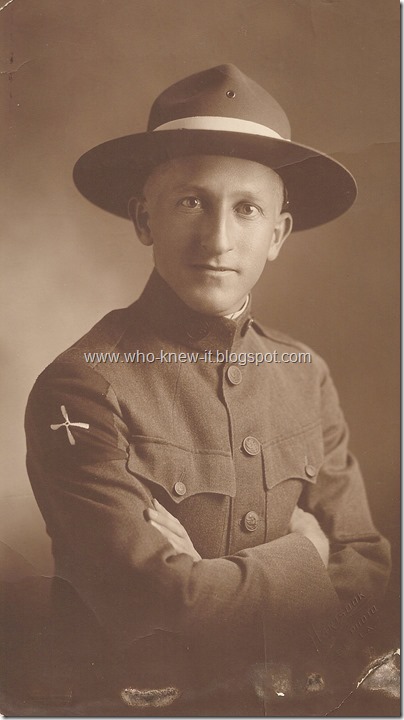
Sigmund Levy, c. 1918

My paternal grandfather, Sigmund Levy, served in WWI – I’ve written a lot about his time as a Flying Cadet (he had to sit on a pillow when flying!).  But it all became a little more real when I discovered some new information.


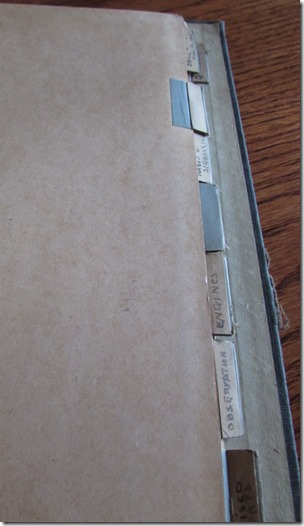
It looks like just an old binder but when I opened it up, I found this on the inside cover.


This is my grandfather’s “stuff” from his Flying Cadet Days!  It looks to be class notes, sketches, schedules – so much information that I could never capture it all.

And look – this shows the instructions for newly arrived cadets and that he was assigned to Squadron A 61. 

Squad Assignment

Binder tabs didn’t look all that much different in 1918.  Unfortunately, he didn’t seem to use them and just put everything loose inside the binder.


Lots of notes.  My grandfather didn’t have great handwriting but this is all really tough to read.  I’m sure he figured he’d be the only one to read it plus it’s all Greek to me.


He had a schedule of his daily activities.  This card was compliments of Aviator’s Exchange.  It’s interesting to see their advertisements along the side of the card – the Aviators could check their excess baggage free of charge.  I also notice they had Aviation Stationery – I wonder if that’s where Sig bought the stationery he used to write letters to my grandmother (which are safely tucked away in my closet).

Schedue Card

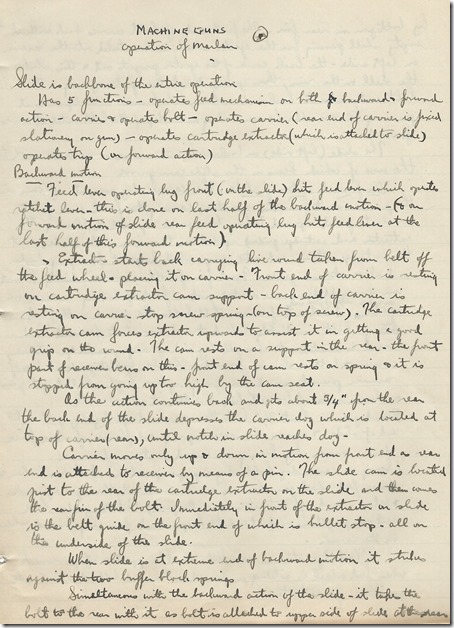
On Mondays and Tuesdays at 8:10 a.m., Sig attended Machine Guns (class, I guess).  Here’s a sample of his notes.

Machine Guns

Wanna know more about the Theory of Flight and History of Flying?  Good luck with that (I can barely read a word).

History of Fllight

And they learned about the Articles of War – I love that he reminded himself that Article II was important. 

Articles of War

Inside were a couple of folders – this one was about Airplanes.

Airplanes

The first page was an airplane sketch.  An airplane sketch today would sure look different.

Airplane Sketch


Of course they learned about Morse Code.  Is that even used these days?


Morse Code

They were really getting prepared.

Map Signs

Map Signs Detail

Thankfully, Sig never left the United States and went on to lead a long and productive life.  I don’t remember him ever talking about his time as a Flying Cadet and for that matter, I don’t remember my dad mentioning it, either.  Did Sig not talk about it or was I not listening?

*********************************************************************
As we honor the fallen this Memorial Day, I take this opportunity to remember my two ancestors who were killed in the line of duty.

My 2nd great grandfather, William J. Brooks, killed at the Battle of Fredericksburg, December 13, 1862.  Buried in Dials Cemetery, Laurens County, South Carolina.


And my mother’s step brother, Robert Melvin Hunter, killed aboard the USS Oklahoma, Pearl Harbor, on December 7, 1941.  Buried in the National Memorial Cemetery of the Pacific (aka The Punchbowl) in Honolulu, Hawaii.

Hunter Robert Melvin

Rest in peace.